For a very long time, retirement planning in Trinidad and Tobago came with one wonderfully convenient number:
60.
Work until 60. Retire at 60. Collect your pension at 60.
Simple.
Except retirement was never quite that simple — and the changes now taking place in the National Insurance System are making that much harder to ignore.
You may have heard some version of:
“The retirement age is now 65.”
That is not quite what happened.
And if you are anywhere from your 30s to your late 50s, the distinction matters.
Is the NIS retirement age in Trinidad and Tobago now 65? Not quite.
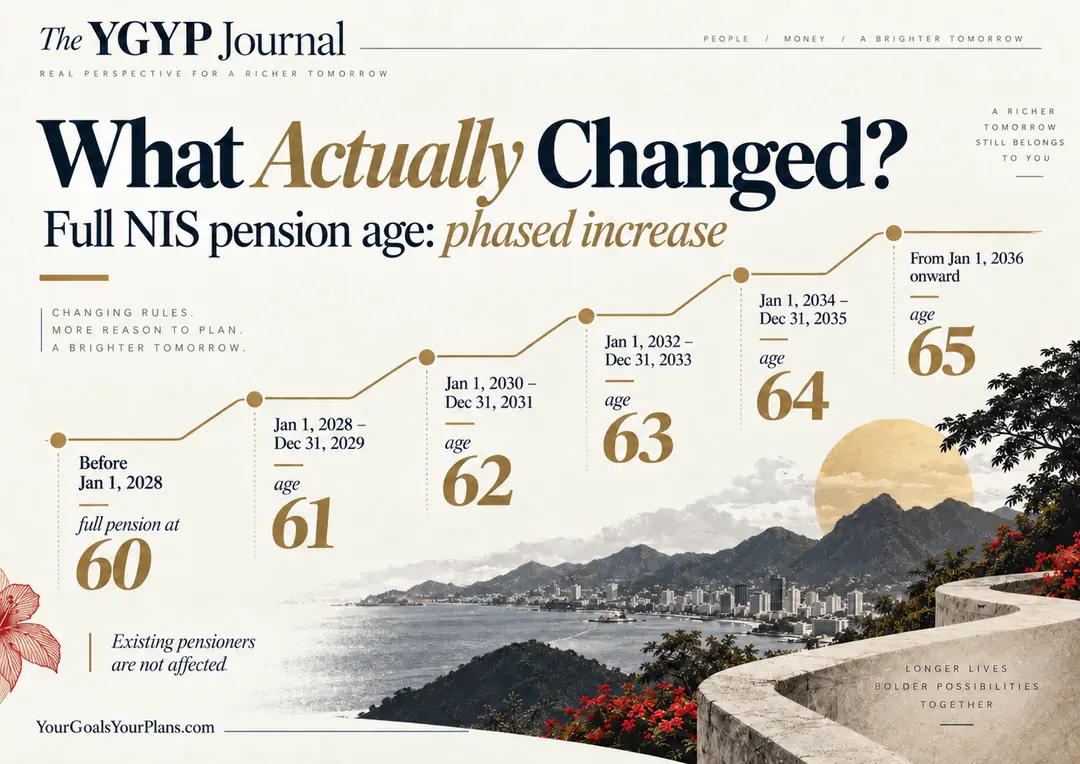
What Government announced for the National Insurance System is a phased increase in the age at which someone becomes eligible for a full NIS retirement pension.
It does not jump immediately from 60 to 65.
Under the schedule announced in the 2026 Budget Statement, there will be no change for someone who retires at age 60 before January 1, 2028. From 2028–2029, the age for a full NIS pension moves to 61; then 62 for 2030–2031, 63 for 2032–2033, 64 for 2034–2035, and finally 65 from 2036 onward. Existing pensioners are not affected by the announced change.
That’s an important distinction.
Your employment retirement age and the age at which you qualify for a particular retirement benefit do not necessarily have to be the same thing.
Depending on where you work, the date you stop working may be affected by your employment arrangements, occupational pension rules, legislation or collective agreements.
So it is entirely possible for the date at which someone stops receiving a salary and the date at which a particular pension becomes payable to be different.
And that is where this story becomes much more interesting than simply saying, “retirement is now 65.”
Retirement has an income problem
Most of us think about retirement as an age.
I would rather you think about retirement as an income event.
One day your salary stops.
Your electricity bill does not.
Neither does your grocery bill, property expenses, insurance, medical costs, entertainment, transportation or the occasional desire to take a holiday and behave as though you didn’t spend the previous 40 years working.
The real retirement question therefore isn’t:
“What age can I retire?”
It is:
“When I stop working, what is going to pay me?”
That is why retirement planning ultimately comes back to a simple idea: you don’t retire on a lump sum; you retire on income.
That income may include NIS.
It may include an employer pension.
It may include a private pension or approved annuity.
It may include investments, rental income, business income, savings or other assets.
For many people, the answer will eventually be some combination of several of these.
NIS was never meant to do the entire job
There is actually a useful clue in the way NIBTT itself describes the Retirement Benefit: it is designed to supplement income after retirement.
That word matters.
Supplement.
The changes taking place within the National Insurance System make one thing particularly difficult to ignore: relying on one future source of retirement income gives you very little personal control.
The combined NIS contribution rate paid by employers and employees increased from 13.2% to 16.2% effective January 5, 2026. A further increase to 19.2% from January 4, 2027 was included in the Government’s announced reform schedule. NIBTT’s current 2026 contribution tables confirm the 16.2% rate now in effect.
And the pressures behind the reforms did not appear overnight.
NIBTT’s Eleventh Actuarial Review, based on the system as at June 2020, identified a growing pensioner population, increasing life expectancy and a worsening ratio between pensioners and contributors as significant long-term pressures on the system.
But your personal response does not require you to become an actuary.
It requires you to build more of your own retirement capacity.
The closer you are to retirement, the more important the gap becomes
Imagine that you expect to stop working at 60.
Now list the income you expect to receive beginning the following month.
Not eventually.
Not “I have a pension somewhere.”
Not the value of your house.
Monthly income.
How much?
From where?
When does each source begin?
Does it increase with inflation?
How much of your present lifestyle can it realistically support?
Those questions expose something that a retirement age never could.
Two people can both retire at 60 and have completely different retirements.
One may have NIS, an employer pension, a private pension, investments and low debt.
The other may have NIS and a mortgage.
Same age.
Entirely different financial reality.
And younger workers shouldn’t ignore this
If you are 35 or 42, retirement reform can feel like news for somebody else’s generation.
It isn’t.
You actually have one of the greatest advantages in the entire equation:
time.
Not because you need to spend the next 25 years worrying about old age.
Quite the opposite.
A longer runway gives you more opportunity to build retirement income gradually, allow investments and pension contributions time to compound, deal with debt before retirement and adjust when life inevitably refuses to follow the spreadsheet.
Someone who begins thinking seriously about retirement at 35 has options that may simply not exist for someone beginning at 59.
That’s not a judgement.
It’s mathematics.
So what should you do now?
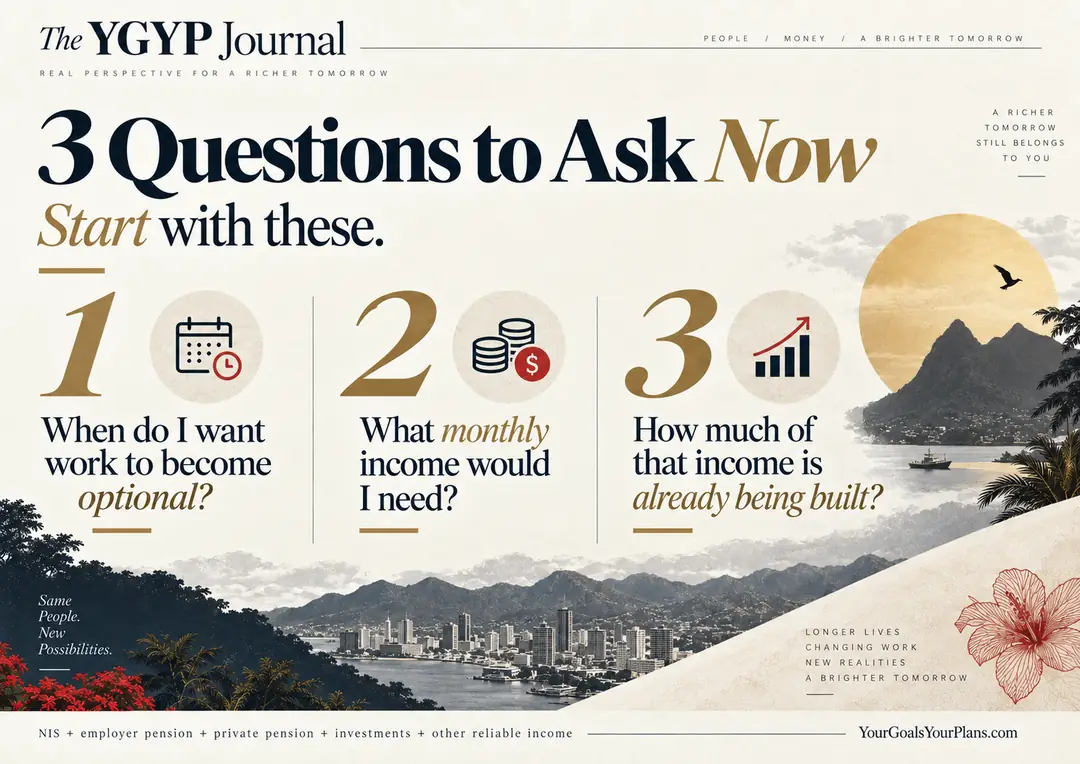
Start with three numbers.
1. When do you want work to become optional?
That is your desired retirement age — regardless of when any particular pension begins.
2. What monthly income would you need at that point?
Think income, not simply “a lump sum.”
3. How much of that income is already being built?
Include NIS, employer pensions, private pensions, investments and other reliable future income sources.
The difference between what you need and what those sources are expected to provide is your real retirement planning problem.
And problems are much easier to solve when we can actually see them.
The bigger lesson
The most important thing about the movement toward 65 isn’t the number 65.
It is the reminder that retirement rules can change.
Governments change policy. Employers change pension arrangements. Markets change. Inflation changes. Life changes.
Your retirement strategy therefore needs something those things don’t give you automatically:
personal control.
The objective isn’t to predict everything that will happen over the next 10, 20 or 30 years.
It is to build enough financial capacity that when things do change, you have choices.
Because ultimately, retiring well isn’t about reaching the correct birthday.
It’s about reaching a point where your income no longer depends entirely on your ability to keep working.
And that is a very different goal.
Do you know how ready you are?
Knowing your desired retirement age is only the beginning. Take the 3-Question Retirement Readiness Check to see whether your future income is beginning to match the retirement you want.
TAKE THE RETIREMENT READINESS CHECK →
Sources & Further Reading
Ministry of Finance, Trinidad and Tobago — Budget Statement 2026. Use this as the source for the announced 2028–2036 full-pension-age schedule and the treatment of existing pensioners. Official 2026 Budget Statement
National Insurance Board of Trinidad and Tobago — 2026 Earnings Classes and Contribution Rates. Use this for the current 16.2% contribution rate. NIBTT Contribution Rates
National Insurance Board of Trinidad and Tobago — Eleventh Actuarial Review. Use this for the demographic and sustainability discussion. NIBTT Eleventh Actuarial Review
National Insurance Board of Trinidad and Tobago — Retirement Benefit. Use this specifically for NIBTT’s description of the retirement benefit as supplementing retirement income. NIBTT Retirement Benefit information
This article provides general financial education and should not be treated as personalised financial advice. Individual pension, tax, insurance and retirement circumstances differ.

![[GRAPHIC — THE ASSET BEHIND THE ASSETS] Caption: Before the house, investments and retirement plan can be sustained, there is usually a person producing the income.](https://yourgoalsyourplans.com/wp-content/plugins/ygyp-journal-experience/assets/images/journal-162616f0f29dab-1080.webp)