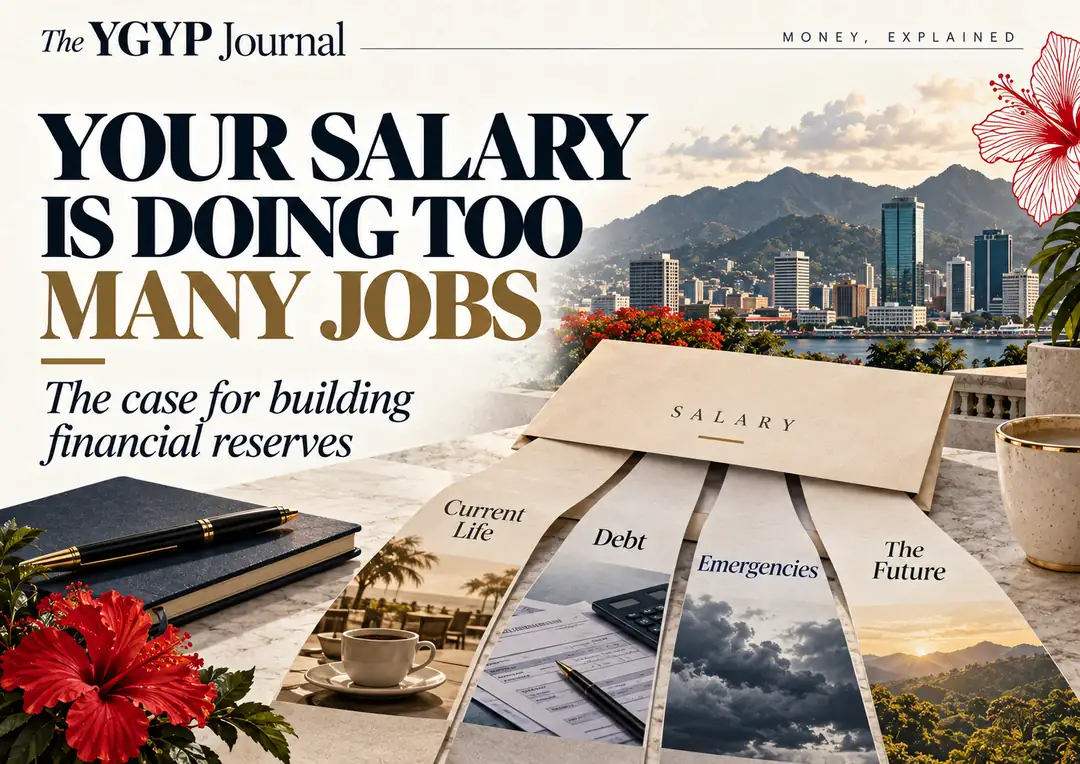
Your salary arrives.
Before it has time to settle in, it is assigned to the mortgage or rent, groceries, utilities, transport, debt payments, school expenses, family obligations and whichever appliance has chosen that particular week to resign without notice.
Then we ask it to do something else.
Build an emergency fund. Invest. Prepare for retirement. Pay for a holiday. Handle a medical expense. Take advantage of an opportunity. And, ideally, leave enough behind for a life that contains more than bills.
One stream of income is being asked to fund the present, repair the past, absorb the unexpected and finance the future.
No wonder a perfectly respectable salary can still feel as though it is disappearing.
The problem is not always that you earn too little. Sometimes the problem is that your salary is doing too many jobs—with no reserves to share the load.
A salary is a flow, not a safety net
A salary is money moving through your life. It is meant to arrive regularly and meet regular demands.
But regular income can create the impression that the next paycheque will solve whatever the current one could not. That works until something interrupts the sequence: illness, job loss, a major repair, an urgent family need or a period when expenses simply arrive faster than income.
At that point, the weakness is not necessarily the size of the salary. It is the absence of money that was allowed to remain unspent.
That is what a financial reserve is.
A financial reserve is money set aside in advance to meet a future demand without borrowing, selling long-term assets or disrupting essential bills.
It gives your financial life somewhere else to turn.
Research from the U.S. Consumer Financial Protection Bureau found substantial differences in people’s ability to meet financial obligations, their debt and credit profiles, and their overall financial well-being depending on the level of emergency savings they had accumulated. The research is U.S.-based, so the amounts should not be treated as Trinidad and Tobago household benchmarks. But the underlying principle travels well: income helps you operate; reserves help you recover. (CFPB)

Not every surprise is an emergency
One reason people struggle to build reserves is that too many different expenses are placed under one label: emergency.
But some expenses are not emergencies. They are irregular and entirely predictable.
Vehicle servicing, school expenses, annual insurance premiums, Christmas, Carnival, property maintenance and replacing an ageing appliance may not appear every month, but their eventual arrival should not be shocking. December, in particular, has an excellent record of turning up every year.
This distinction matters because different jobs require different pools of money.
- Operating money pays the ordinary monthly bills.
- Lifestyle or sinking funds prepare for predictable but irregular expenses.
- An emergency reserve absorbs genuine disruptions and urgent surprises.
- An opportunity reserve gives you room to act when a worthwhile possibility appears.
- Retirement savings and investments build future income over many years.
When all of these jobs are assigned to one bank balance, the money becomes difficult to read. A balance of TT$10,000 may look reassuring—until TT$4,000 belongs to next month’s bills, TT$3,000 is meant for an annual expense and the remaining TT$3,000 is the only protection against an actual emergency.
The account balance is not the same thing as available money.
The Trinidad and Tobago version of financial pressure
In Trinidad and Tobago, a salary often supports more than the person who earns it.
There may be children, parents, relatives, household employees or a family business depending on the same income. A person can be paying a mortgage, maintaining a vehicle, helping with medical costs and quietly acting as the family’s emergency fund at the same time.
That generosity is part of how many families function. It also means that a disruption in one household can travel quickly through several others.
This is why financial resilience cannot be measured only by salary or job title.
Two people may earn the same income. One has cash reserves, manageable debt, insurance and money steadily moving toward retirement. The other has no reserve and several people depending on every paycheque.
On paper, their salaries are identical.
In real life, their room to manoeuvre is not.
There is useful local context here too. Trinidad and Tobago’s 2023 National Financial Inclusion Survey reported that 75% of respondents indicated that they actively save. But where that money is kept is interesting: cash kept at home was reported as a savings method by 82%, while 52% reported saving through a bank account. Respondents could report more than one method.
So the issue is not simply whether people save. An equally useful question is what job that savings is expected to perform. Money being held for next month’s expenses is different from an emergency reserve. An emergency reserve is different from retirement money. And savings intended for a known annual expense should not have to compete with all three.
This is part of the work we do through Your Goals Your Plans: helping people see income, reserves, protection, investment and future retirement income as parts of one financial system rather than unrelated decisions.
It is also the purpose of Money, Explained. Before deciding what financial product or strategy belongs in the plan, it helps to understand what your money is already being asked to do — and which jobs currently have no support at all.
Reserves do more than pay for emergencies
The obvious purpose of a reserve is to pay a bill when something goes wrong.
Its less obvious purpose is to protect the rest of your financial plan.
Without cash reserves, a car repair may go onto a credit card. A period away from work may require a loan. A medical expense may interrupt pension contributions. A family emergency may force you to sell an investment at the wrong time.
One problem then creates a second problem.
The repair becomes debt. The debt reduces future cash flow. Reduced cash flow slows saving. And a temporary disruption begins influencing decisions for months or years.
A reserve interrupts that chain.
It can also create opportunity. Cash set aside deliberately may allow you to pay for professional training, make a planned move, start a small venture or take advantage of an investment opportunity without sacrificing the money that keeps the household stable.
That is why reserves are not simply defensive. They buy time, negotiating power and choice.
How much should you keep?
There is no single amount that is correct for every household.
A person with secure employment, multiple household incomes and few dependants may require a different reserve from someone who is self-employed, supports relatives or has variable income.
Your target should reflect:
- essential monthly commitments;
- the stability and number of household income sources;
- debt obligations;
- the number of people who depend on you;
- health and insurance arrangements; and
- how quickly your income could realistically be replaced.
A commonly used emergency-fund benchmark is around three to six months of living expenses, but it should be treated as a starting point rather than a universal rule. Income stability, dependants, debt, available protection and how quickly lost income could be replaced all affect how much breathing room a household may need.
For many people, a full reserve covering several months will take time to build. That does not make the goal unrealistic. It means the goal needs stages.
Start with enough to prevent a common disruption from becoming new debt. Then work toward one month of essential expenses. From there, build toward three months and, where appropriate, six months or more.
The first target should be meaningful enough to help, but achievable enough that you do not abandon it.

Build the system before you test your willpower
The most reliable reserve is not usually created from whatever happens to remain at the end of the month. Money without an assignment has a remarkable ability to find one.
A stronger approach is to decide in advance.
1. Separate the jobs.
Use clearly labelled accounts or savings pots for emergencies, predictable annual costs, opportunities and long-term goals. They do not all need to begin with large balances. They do need distinct purposes.
2. Move money on payday.
Automate a transfer before the salary becomes absorbed into general spending. Consistency matters more than an impressive first deposit.
3. Use irregular income deliberately.
Bonuses, commissions, refunds and other windfalls can accelerate a reserve. You do not have to save every dollar, but decide on the portion before the money arrives.
4. Refill what you use.
Using an emergency fund for a genuine emergency is not failure. That is the job. Once the disruption passes, rebuilding it becomes the next priority.
5. Do not ask cash to carry every risk.
Savings can manage smaller shocks and short interruptions. Insurance is designed for risks that could be too large to fund efficiently from cash alone. Investments and pensions have a different job again: building long-term income. A resilient plan uses the right tool for the right risk.
What if there is nothing left to save?
This is where financial advice can become unhelpfully cheerful.
If every dollar is already committed, “just save more” is not a strategy.
Begin by looking for the pressure point. Is too much income servicing debt? Are irregular expenses repeatedly being treated as surprises? Is the household supporting commitments that have never been discussed openly? Has lifestyle expanded each time income increased? Or is the current income genuinely insufficient for the household’s essential needs?
Each diagnosis leads to a different response.
You may need to restructure debt, reduce a recurring cost, set clearer family boundaries, direct a future salary increase differently or build an additional source of income. The purpose of a money plan is not to produce a perfect percentage. It is to reveal what your salary is currently being asked to do—and decide which jobs need another source of support.
Even a small reserve changes the direction of the plan. It turns the next unexpected expense from a guaranteed borrowing event into something you may be able to absorb.
The bigger lesson
Income is essential, but income alone is not financial security.
A high salary with no reserves can be fragile. A more modest income with manageable commitments, appropriate protection and steadily growing reserves may be far more resilient.
The goal is not to keep piles of money sitting idle while the rest of your life waits. It is to give part of your money the specific job of protecting everything else you are building.
Your salary should not have to solve every problem in real time.
Some of today’s income should become tomorrow’s breathing room.
So ask yourself one useful question:
If your salary stopped for 90 days, which parts of your life would still be funded?
The answer will show you where your reserve needs to begin.
Is Your Income Aligned With the Life You’re Building?
Bills are only one job your income has to perform. Take the 1-Minute Money Alignment Check and see which part of your financial plan is carrying the greatest pressure.
Sources & Further Reading
Consumer Financial Protection Bureau — Emergency Savings and Financial Security
Research examining the relationship between emergency savings, financial obligations, debt and financial well-being. CFPB research
Government of Trinidad and Tobago — National Financial Inclusion Survey Report 2023
Local research covering saving behaviour and use of financial services in Trinidad and Tobago. National Financial Inclusion Survey 2023
Investor.gov — Emergency Fund Guidance
Consumer guidance discussing an emergency reserve of approximately three to six months of living expenses. Investor.gov guidance
This article provides general financial education and should not be treated as personalised financial advice. Individual savings, investment, insurance, tax and financial circumstances differ.

![[GRAPHIC — THE ASSET BEHIND THE ASSETS] Caption: Before the house, investments and retirement plan can be sustained, there is usually a person producing the income.](https://yourgoalsyourplans.com/wp-content/plugins/ygyp-journal-experience/assets/images/journal-162616f0f29dab-1080.webp)