The market moved. Did your retirement plan?
There is something slightly dangerous about a retirement plan that has not changed in ten years.
Not necessarily because the original plan was bad.
It may have been very good.
The problem is that while the plan sat there quietly behaving itself, life kept moving.
Your income changed.
Your expenses changed.
You got older.
Retirement got closer.
The cost of living changed.
Interest rates moved.
Investment opportunities changed.
Markets had good years, bad years and years that made everybody suddenly become an economist on WhatsApp.
And yet sometimes the retirement plan remains exactly where we left it.
That is why I increasingly come back to one simple idea:
Retirement planning is not set-and-forget.
It does not mean changing your investments every time there is an alarming headline.
It does not mean trying to predict the market.
And it certainly does not mean chasing whichever investment happens to be paying the highest rate this month.
It means recognising that a retirement plan is built on assumptions — and occasionally asking whether those assumptions are still reasonable.
First, a confession: I am not an economist
I should probably say this upfront.
I am not an economist.
I do, however, spend what may be a slightly unreasonable amount of time following economic news.
Not because I am planning to predict the next interest-rate decision, become a sovereign-debt analyst or spend my evenings enthusiastically studying yield curves.
Let us not get carried away.
I follow it because retirement planning does not happen in a vacuum.
Inflation matters.
Interest rates matter.
Government borrowing matters.
Global markets matter.
Energy prices matter — particularly for an economy such as Trinidad and Tobago’s.
Events happening thousands of kilometres away can eventually find their way into our grocery bills, investment returns, businesses, exchange-rate pressures and the cost of the retirement lifestyle we are trying to fund.
That relationship between our personal financial lives and the wider economy is something I explored recently in The Economy Doesn’t Care About Your Plan.
So economics may not be my specialty.
But understanding enough of what is happening to ask better retirement-planning questions absolutely matters to me.
You do not need to become an economist to retire well either.
But I do believe you should understand enough about the environment surrounding your money to recognise when it may be time to review the plan.
Your retirement plan is built on assumptions
Think about what happens when we create a retirement projection.
We make assumptions.
How much income might you need?
How much are you saving?
How many years remain before retirement?
What return might your investments earn?
How much might prices rise over time?
How long might your retirement income need to last?
What other income might be available?
None of those numbers exists in stone.
That is why a retirement projection should not be mistaken for a prediction.
It is a planning model.
And models need reviewing.
Suppose you created a retirement strategy at 40 and you are now 52.
Your investment portfolio may be larger.
Your mortgage may be smaller.
Your children may be older.
Your salary may be higher.
Your business may have grown.
Your expected retirement lifestyle may have changed considerably.
And your time horizon has definitely changed.
Why, then, should the investment strategy automatically remain identical?
This becomes particularly important as we move into the years when financial decisions become harder to reverse. I explored that issue further in The Financial Decisions That Get Harder After 55.
The market moved. What exactly does that mean for you?
This is where things become interesting.
There has been significant bond-market activity involving Trinidad and Tobago during 2026.
On January 22, 2026, the Government of Trinidad and Tobago issued a US$1 billion, 10-year sovereign bond carrying a 6.50% coupon and maturing in January 2036.
According to the Ministry of Finance, investor demand was approximately 2.5 times the amount offered. The issue was structured for the international market, with denominations beginning at US$200,000 plus increments of US$1,000. [1]
That last detail matters.
Because hearing that an investment exists does not automatically mean that the specific security is designed for the average individual investor.
Then, on July 9, 2026, Trinidad and Tobago returned to the international market with another US$800 million sovereign bond issue. The Ministry reported demand of approximately four times the amount offered. [2]
There have also been developments closer to the domestic market.
In March 2026, the Trinidad and Tobago Securities and Exchange Commission recorded a TT$377 million mortgage-backed variable-rate Social Bond issue by the Trinidad and Tobago Mortgage Bank. [3]
And then there are bonds that were issued previously but continue to trade in our secondary market.
The Trinidad and Tobago Stock Exchange, for example, lists National Investment Fund securities including NIF Series B, which carries a 5.70% coupon and matures in 2030, and NIF Series C, with a 6.60% coupon and a 2038 maturity. These were originally issued in 2018 and remain active securities rather than new 2026 bond issues. [4]
Now, when I see numbers such as 5.7%, 6.5% or 6.6%, my first reaction may be similar to yours:
Hmm. Interesting.
But that should not be the end of the analysis.
It should be the beginning.
Because a percentage printed beside the word bond does not automatically mean we have discovered the answer to retirement.
So what exactly is a bond?
Let us make this simple.
When you buy a bond, you are essentially lending money to the issuer.
That issuer might be a government, government-related organisation or company.
In exchange, the issuer generally agrees to pay interest and repay the principal according to the terms of the bond.
That can make bonds particularly interesting in retirement planning because they may provide something retirees often value:
income and a degree of predictability.
But bonds still have risk.
That is important.
“Fixed income” does not mean “nothing can go wrong.”
There can be credit risk.
Interest-rate risk.
Inflation risk.
Liquidity risk.
And, depending on the investment, currency risk may also matter.
Investor.gov identifies credit, interest-rate, inflation and liquidity risk among the important risks bond investors should understand. [5]
Which brings us to one of those finance concepts that sounds much more frightening than it needs to be.
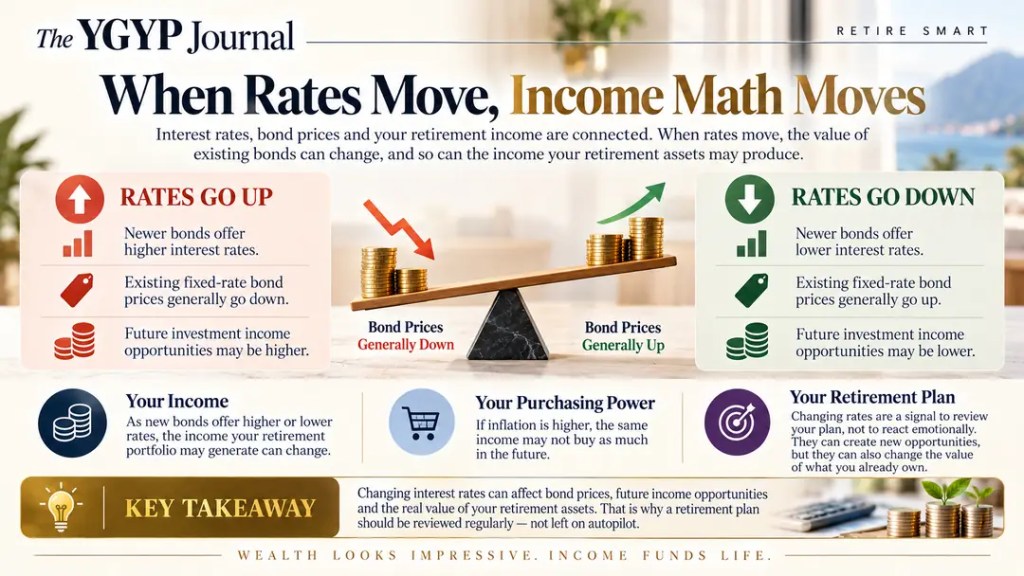
Interest rates and bonds: think of a seesaw
If new bonds begin being issued at higher interest rates, an older fixed-rate bond paying a lower rate becomes less attractive by comparison.
Its market price may therefore fall.
If market interest rates fall, an existing fixed-rate bond paying an attractive higher rate may become more desirable.
Bond prices and market interest rates therefore generally move in opposite directions. [6]
Think:
rates up → existing fixed-rate bond prices generally down
rates down → existing fixed-rate bond prices generally up
That does not necessarily matter in exactly the same way to every investor.
Someone intending to hold a suitable bond to maturity may be thinking primarily about the income expected along the way and the repayment of principal at maturity, subject of course to the issuer meeting its obligations.
Someone who may need to sell that bond beforehand needs to think much more carefully about what its market value could be at that time.
Already you can see why simply asking:
“What rate is this bond paying?”
is not enough.
A better set of questions would be:
When does it mature?
Who issued it?
What currency is it in?
Is the rate fixed or variable?
Could I need this money before maturity?
How easily could I sell it?
And perhaps the most important retirement-planning question:
What job is this investment supposed to do in my portfolio?
Retirement changes the job of your money
This is one of the most important shifts in retirement planning.
While you are working, your salary is doing a lot of the heavy lifting.
Every month new income arrives.
You can invest some of it.
Save some.
Recover from mistakes.
Wait out market downturns.
As retirement approaches, that equation begins to change.
Eventually, instead of your salary supporting your investments, your accumulated assets increasingly have to support you.
That is why I believe retirement planning is much easier to understand when we stop thinking only about the size of the retirement fund and begin thinking about the income the assets eventually need to produce.
I explored that idea in You Don’t Retire on a Lump Sum. You Retire on Income.
Once we start thinking in terms of income, different parts of a portfolio begin to have different jobs.
Some money may need to provide growth.
Some may need to provide income.
Some may need to provide stability.
Some should probably remain accessible.
And some may need to continue growing for many years because retirement itself can last decades.
This is why I do not particularly like the idea that retirement automatically means moving everything into the “safest” possible investment.
Safety has more than one meaning.
Avoiding market volatility is one type of safety.
But keeping up with inflation is another.
Not running out of money is another.
Having enough liquidity when something unexpected happens is another.
A retirement portfolio may therefore require a balance of risks, not the complete elimination of risk.
Asset allocation itself is built around this idea: different asset classes can serve different purposes, and the appropriate balance generally changes with goals, time horizon and risk tolerance. [7]
And then there is inflation — the quiet troublemaker
Imagine an investment paying you 5%.
That sounds good.
But now suppose the cost of the lifestyle you are funding is also rising.
Your investment statement may tell you what the money earned.
It does not automatically tell you what that money can still buy.
Inflation reduces purchasing power, which is particularly relevant when an investor receives a fixed stream of interest over a long period.
That is why retirement planning must think beyond the headline return.
A retiree is ultimately trying to preserve purchasing power.
Food.
Utilities.
Travel.
Healthcare.
Insurance.
Home maintenance.
Transportation.
The little luxuries you would still like to enjoy.
If those costs rise over a 20- or 30-year retirement, then part of your money may still require growth.
This is where investments with greater long-term growth potential may continue to have a role even after retirement begins.
Not because shares are automatically better than bonds.
And not because bonds are better than shares.
They are doing different jobs.
No single investment is the retirement plan
This is perhaps the point I want readers to remember most.
A bond is not a retirement plan.
A mutual fund is not a retirement plan.
An annuity is not a retirement plan.
A pension is not a retirement plan.
A rental property is not a retirement plan.
Your business is not automatically a retirement plan either.
Each can potentially become part of one.
A strong retirement-income structure may eventually involve several sources.
Depending on the individual, those might include pension income, NIS benefits where applicable, annuity income, investment withdrawals, interest from fixed-income securities, dividends, business income, property income or cash reserves.
Not everyone needs all of them.
But there is value in understanding that retirement income can be deliberately constructed.
That matters because different income sources behave differently.
Some may be more predictable.
Some may fluctuate.
Some may grow.
Some may be fixed.
Some may be highly liquid.
Some may lock your money away.
Some may be exposed heavily to inflation.
Others may help provide growth over time.
The objective is not to collect as many investments as possible.
The objective is to build an income structure where the pieces work together.
So when a new bond comes out, should you buy it?
My answer is wonderfully irritating:
It depends.
I know. Very helpful.
But it really does.
A bond offering an attractive return could be an appropriate fit for one person’s portfolio and completely unsuitable for someone else’s.
Consider two investors.
One is 42, still aggressively building long-term retirement capital and has more than 20 years before retirement.
The other is 61, plans to retire within four years and wants to begin creating more predictable income around particular future expenses.
The same investment could have a very different role for each person.
And even before comparing investments, both individuals should have another layer of money available for genuine short-term surprises.
That is one reason I treat the emergency fund as financial breathing room rather than simply another investment account.
The correct question is therefore not:
“Is this a good investment?”
It is:
“Is this a suitable investment for the job my retirement plan needs done?”
Those are not the same question.
The biggest danger is chasing the market
There is an important balance here.
If I say retirement planning is not set-and-forget, I do not mean your portfolio should become a revolving door.
Markets move every day.
Economic forecasts change.
Interest rates change.
There will always be a new investment everyone suddenly wants to discuss.
Constantly reacting can be just as damaging as never reviewing the plan at all.
So perhaps the better philosophy is:
Do not chase the market. Review the plan.
Rates give you information.
Inflation gives you information.
Markets give you information.
New investment opportunities give you information.
Changes in your own life give you information.
Your retirement plan tells you what to do with that information.
What should trigger a retirement-plan review?
Not every headline.
But certain changes deserve attention.
A meaningful shift in your expected retirement date.
A substantial increase or decrease in income.
A major change in your business.
A mortgage being completed.
A significant change in your investment portfolio.
Changes to pension arrangements.
A new retirement-income opportunity.
A material change in inflation or interest rates.
A major life event.
Or simply the passage of time.
Sometimes the plan needs a major adjustment.
Sometimes the review concludes:
Actually, we are still on track. Leave it alone.
That is useful information too.
Good planning does not mean constantly changing things.
Sometimes good planning means knowing why you are not changing them.

Your portfolio should become more intentional as retirement gets closer
At 30, retirement can tolerate a fair amount of abstraction.
At 55, not so much.
The closer you get, the more specific the questions should become.
How much income do I actually need?
Which expenses will continue?
Which debts will still exist?
What income will be predictable?
What income will depend on markets?
What assets will I draw from first?
How much should remain invested for growth?
How much income stability do I want?
How much cash should be available?
What happens if markets fall in my first few years of retirement?
What happens if I live much longer than expected?
That is when retirement planning begins shifting from:
“How much have I accumulated?”
to:
“How will these assets actually produce my life?”
That is a very different conversation.
It is also exactly why the Freedom Forecast™ looks beyond a single retirement balance and brings expected income, investments, reserves and retirement needs into one planning picture.
The market will move again
I can confidently predict at least one thing about financial markets:
They will change.
I have no idea exactly how.
Neither does anybody else.
There will be periods when bonds look especially attractive.
Periods when equities perform strongly.
Periods when cash suddenly feels comforting.
Periods when inflation becomes the conversation.
Periods when interest rates dominate the headlines.
And probably several periods when all of us would prefer not to open our investment statements at all.
That is normal.
The goal of retirement planning is not to perfectly predict each of those periods.
The goal is to build a strategy capable of navigating them.
So when you hear about the next bond issue, the next market rally or the next economic concern, pay attention.
Be curious.
Ask questions.
Learn.
But then bring the conversation back to the thing that actually matters:
your plan.
Does the opportunity fit?
Has the risk changed?
Has your timeline changed?
Has the income you need changed?
Are the assumptions you made five years ago still appropriate today?
Because retirement planning is not set-and-forget.
It is a living strategy for turning the assets you build today into the income, choices and freedom you will need tomorrow.
And every so often, it deserves another look.
Retire Smart
The market moved. Did your retirement plan?
If it has been some time since you reviewed your retirement assumptions, this may be a good time to revisit the numbers — not because every market movement requires action, but because your strategy should continue to reflect where you are now and where you are trying to go.
You can start by running your Freedom Forecast™ to see how your expected retirement income, investments and current assumptions fit together.
References & Further Reading
Ministry of Finance, Government of Trinidad and Tobago. USD 1.0 Billion Sovereign Bond Successfully Issued in the U.S. Market. January 25, 2026. This confirms the US$1 billion size, 10-year tenor, 6.50% coupon, January 2036 maturity, denomination structure and approximately 2.5× investor demand. finance.gov.tt
Ministry of Finance, Government of Trinidad and Tobago. USD 800 Million Sovereign Bond Successfully Issued in the U.S. Market. July 9, 2026. The Ministry reported that the issue was approximately 400% oversubscribed.
Trinidad and Tobago Stock Exchange. Bond Securities / National Investment Fund Series B and Series C. TTSE lists NIF Series B at 5.70%, maturing August 9, 2030, and NIF Series C at 6.60%, maturing August 9, 2038. TTSE
Investor.gov — U.S. Securities and Exchange Commission. Bonds — FAQs. Useful for the explanations of credit risk, interest-rate risk, inflation risk, liquidity risk and call risk. Investor
Investor.gov — U.S. Securities and Exchange Commission. Fixed Income Investments — When Interest Rates Go Up, Prices of Fixed-Rate Bonds Fall. This is the source supporting the article’s “seesaw” explanation of bond prices and interest rates.
Investor.gov — U.S. Securities and Exchange Commission. Beginners’ Guide to Asset Allocation, Diversification, and Rebalancing. Supports the discussion around different asset classes serving different roles, changing allocations as retirement approaches, and rebalancing rather than chasing markets.
This article provides general financial education and should not be treated as personalised investment, financial, pension, tax or insurance advice. References to particular securities, issuers, rates or investment categories are included for educational illustration and do not constitute a recommendation to buy, sell or hold any security. Investment suitability depends on your individual objectives, financial circumstances, time horizon, liquidity needs and tolerance for risk.